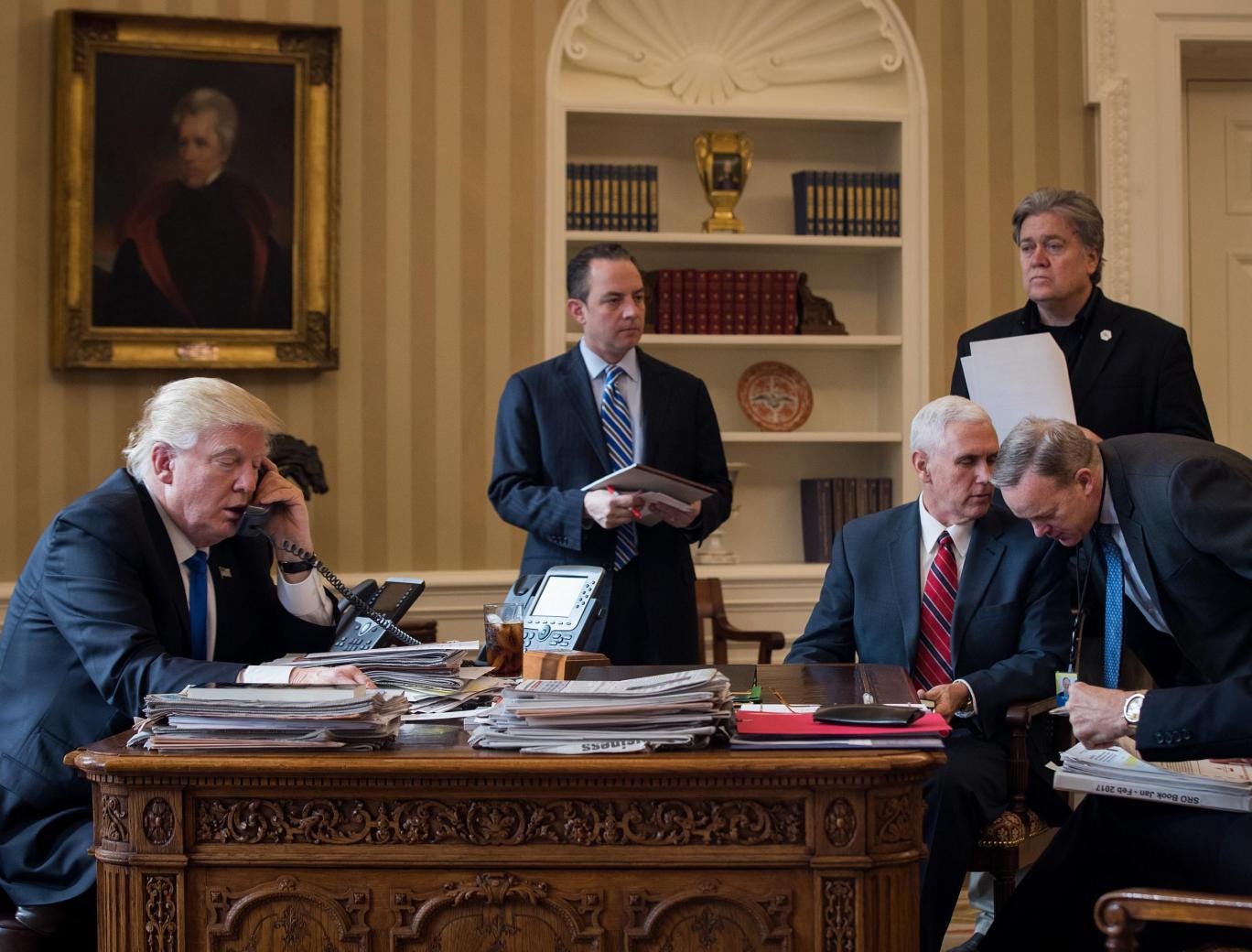
On most Left-wing establishment political news sites, on any given day, readers will find no shortage of stories still advancing the Democratic narrative that the only reason their party’s nominee, Hillary Clinton, lost to a former reality TV star and billionaire real estate mogul was because Russia “hacked the election” in favor of Donald J. Trump – who, by the way, was working in collusion with the Kremlin.
For example, at this writing, Politico published a story headlined, “Nunes, White House defiant as Russia controversy deepens.” The gist of it is a) Russia “hacked the election” for Trump; and b), the House Intelligence Committee chairman, Devin Nunes, R-Calif., is the latest target of Democratic ire because he briefed the president of the United States – who stands wrongfully accused of collusion – that yes, he very much was under surveillance by former President Obama’s regime.
But at the same time Politico – likely unwittingly – was running a story that proves beyond a doubt that the Russia-Trump collusion narrative was completely fabricated by Democrats and perpetuated by their allies in the discredited establishment media. (RELATED: Talk Radio Host Mark Levin Says Obama Executing “Silent Coup” Against Trump And It Should Be Investigated.)
The detailed story, “Democrats burned by polling blind spot,” lays to rest the fake news Russia-Trump narrative in the first two paragraphs:
As they investigate the forces behind the party’s stunning losses in November, Democrats are coming to a troubling conclusion. The party didn’t just lose among rural white voters on Election Day, it may have failed to capture them in its pre-election polling as well.
Many pollsters and strategists believe that rural white voters, particularly those without college degrees, eluded the party’s polling altogether — and their absence from poll results may have been both a cause and a symptom of Donald Trump’s upset victory over Hillary Clinton in several states.
In other words, Democratic pollsters failed to capture the essence of President Trump’s support because they didn’t bother to go where Trump supporters lived when sampling populations. The “troubling conclusion” is that Clinton lost because the Democratic Party lost voters.
This is not rocket science, though. Rural white voters were written off by the Democratic Party long ago, despite denials from liberal media, in favor of assembling a coalition of minorities and college-educated whites (hint to Democrats: Not all college-educated whites vote for your party, either). And as a result of continually being ignored and even mocked and derided by Democratic presidents, presidential candidates and elected leaders, they flocked to Trump in droves last November.
That’s why Clinton lost.
“The ethnic and racial makeup of the country has dramatically changed, but the laws with respect to affirmative action and diversity have not,” former U.S. Sen. Jim Webb, D-Va., and Navy Secretary under GOP President Ronald Reagan, told Fox News recently. “Clay County, Kentucky, the poorest county in America, is 94 percent white. And if you were in that county, where there’s a 40 percent poverty rate, wouldn’t you think this is reverse discrimination?”
Actually, there is no such thing as “reverse discrimination,” there is only discrimination. But Webb is right in that current federal rules and regulations – enacted via liberal policies through the years – favor all ethnicities except whites, even if the ‘need’ exists for them to be helped.
And over time, white, rural, and working class Americans, once solidly in the camp of Democrats, have been abandoned by the party of “the little guy” and labor unions. This has occurred as liberal policies governing immigration and non-assimilation have dominated most presidential administrations. Democrats looking at U.S. demographic numbers have watched as the percentage of whites in the country has fallen steadily for decades. In fact, the U.S. Census Bureau forecast that, by 2020, white children will already be in the minority. By 2044, whites in general will be a minority in America.
News related to Donald Trump
jueves, 30 de marzo de 2017
martes, 28 de marzo de 2017
Trump budget cuts could jeopardise efforts to end homelessness among war veterans
Homeless advocates in any given state consult the council, whose annual budget is about $3.5 million, on which strategies are working elsewhere as they seek to house veterans. They worry momentum will slow.
“We've learned how to end homelessness,” said Nonie Brennan, chief executive of the nonprofit All Chicago. “It would be a tremendous shame if we were not able to continue to implement these strategies in our communities across the country.”
Adding to the ire and confusion, the budget proposal also says the Trump administration will support Department of Veterans Affairs programmes for homeless and at-risk veterans and their families, but doesn't elaborate. Trump, who promised on the campaign trail to support veterans, wants to give the VA a 6 percent increase.
Still, the federal government needs someone to make sure housing resources are well spent, and to look across agencies for solutions instead of just down at their own, advocates say.
“Without coordination and oversight and giving some thought to how the money should best be spent, the money may not go to the people who need it most,” said Hank Hughes, of the New Mexico Coalition to End Homelessness.
The White House's $1.15 trillion plan, released this month, emphasises military and other security-related spending and slashes many domestic programmes. The proposal is the first step in a lengthy process that requires congressional approval.
Proponents of small government praised it. The interagency council, created during the Reagan administration, is one of 19 independent agencies for which Trump proposed eliminating funding.
“The federal government needs to prioritise what it does,” said Dan Holler at Heritage Action for America, the advocacy arm of the conservative think tank The Heritage Foundation.
It's the community groups and local officials who know best how to help homeless people and other underserved groups in their area, he added. The White House Office of Management and Budget didn't respond to a question about the rationale for eliminating the council.
Navy veteran Stephen Matthews, 55, doesn't want to see a system changed that has helped him and many others.
Matthews was homeless last year and now uses a federal rental assistance voucher to help pay for his apartment in Rhode Island. Some advocates fear that in addition to the loss of the council, fewer rental assistance vouchers will be available for the homeless. The budget proposes a 13.2 percent cut to the Housing and Urban Development Department.
The number of homeless veterans nationwide is down 47 percent, or about 35,000 people, since 2010, but there are roughly 40,000 more, HUD said in August. Homelessness among veterans is effectively ended in Virginia, Connecticut and Delaware and in about 40 communities, according to the council, including New Jersey's most populous county.
“We would not have dared to attempt such a bold goal without their leadership,” said Julia Orlando, director of the Housing, Health and Human Services Center in Bergen County.
The council ensures agencies aren't duplicating spending and efforts, or spending money at cross-purposes, and it serves as a clear way into the federal process for communities tackling the issue, said Jake Maguire, spokesman for the nonprofit Community Solutions, which does similar work to tackle homelessness.
He's hopeful the president, a businessman, will learn more about the council and keep it.
“I think anyone who has worked in business knows that if you have 19 people working on something,” he said, “you need someone coordinating that work.”
“We've learned how to end homelessness,” said Nonie Brennan, chief executive of the nonprofit All Chicago. “It would be a tremendous shame if we were not able to continue to implement these strategies in our communities across the country.”
Adding to the ire and confusion, the budget proposal also says the Trump administration will support Department of Veterans Affairs programmes for homeless and at-risk veterans and their families, but doesn't elaborate. Trump, who promised on the campaign trail to support veterans, wants to give the VA a 6 percent increase.
Still, the federal government needs someone to make sure housing resources are well spent, and to look across agencies for solutions instead of just down at their own, advocates say.
“Without coordination and oversight and giving some thought to how the money should best be spent, the money may not go to the people who need it most,” said Hank Hughes, of the New Mexico Coalition to End Homelessness.
The White House's $1.15 trillion plan, released this month, emphasises military and other security-related spending and slashes many domestic programmes. The proposal is the first step in a lengthy process that requires congressional approval.
Proponents of small government praised it. The interagency council, created during the Reagan administration, is one of 19 independent agencies for which Trump proposed eliminating funding.
“The federal government needs to prioritise what it does,” said Dan Holler at Heritage Action for America, the advocacy arm of the conservative think tank The Heritage Foundation.
It's the community groups and local officials who know best how to help homeless people and other underserved groups in their area, he added. The White House Office of Management and Budget didn't respond to a question about the rationale for eliminating the council.
Navy veteran Stephen Matthews, 55, doesn't want to see a system changed that has helped him and many others.
Matthews was homeless last year and now uses a federal rental assistance voucher to help pay for his apartment in Rhode Island. Some advocates fear that in addition to the loss of the council, fewer rental assistance vouchers will be available for the homeless. The budget proposes a 13.2 percent cut to the Housing and Urban Development Department.
The number of homeless veterans nationwide is down 47 percent, or about 35,000 people, since 2010, but there are roughly 40,000 more, HUD said in August. Homelessness among veterans is effectively ended in Virginia, Connecticut and Delaware and in about 40 communities, according to the council, including New Jersey's most populous county.
“We would not have dared to attempt such a bold goal without their leadership,” said Julia Orlando, director of the Housing, Health and Human Services Center in Bergen County.
The council ensures agencies aren't duplicating spending and efforts, or spending money at cross-purposes, and it serves as a clear way into the federal process for communities tackling the issue, said Jake Maguire, spokesman for the nonprofit Community Solutions, which does similar work to tackle homelessness.
He's hopeful the president, a businessman, will learn more about the council and keep it.
“I think anyone who has worked in business knows that if you have 19 people working on something,” he said, “you need someone coordinating that work.”
jueves, 23 de marzo de 2017
High stakes for Trump on healthcare vote
It's time for Donald Trump, the man who bills himself as the consummate dealmaker, to flex his negotiating muscle - or else.The American Healthcare Act, which rolls back portions of the Obamacare health-insurance reforms, is scheduled for a vote in the House of Representatives on Thursday, and at the moment it's far from certain that there are the 215 votes necessary for passage.
According to the latest media reports on vote counts, there are 29 Republicans currently in the "no" column. Assuming all the Democratic lawmakers present stick together - which seems fairly certain at this point - it would only take 23 Republican defections to sink the bill.
On Tuesday morning the president was on Capitol Hill, to make his final push to rally support for the bill. He reportedly told Republican lawmakers that a loss was "not acceptable" and went with a traditional carrot-and-stick approach.
Vote yes, and Republicans could pick up as many as 10 Senate seats in the midterm elections next year. Send the legislation down to defeat, however, and their congressional majorities were in peril.
"Many of you came in on the pledge to repeal and replace Obamacare," Mr Trump said. "I honestly think many of you will lose your seats in 2018 if you don't get this done."
If that wasn't clear enough, Mr Trump pointed to Congressman Mark Meadows, leader of the recalcitrant group of libertarian-leaning conservative congressmen known as the Freedom Caucus: "I'm going to come after you, but I know I won't have to, because I know you'll vote 'yes'."
Press Secretary Sean Spicer would later say that Mr Trump meant that as a joke, but in politics a joke is often a threat delivered with a smile.
Mr Meadows, by the way, is still a solid no.
Meanwhile, House Speaker Paul Ryan, whose reputation as speaker is being put to his first big test this week, was talking up the president's prowess.
"President Trump was here to do what he does best, and that is to close the deal," he said.
The president as the "closer" has been the theme of the week. Spicer said it on Wednesday, as did Congressman Greg Walden on Monday.
"He knows how to put this together," said the House Energy and Commerce Committee chairman, who helped shepherd the repeal legislation onto the House floor. "He's got great negotiating skills, and we're coming together with it."
All of this underlines what is at stake for the president, Mr Ryan and the rest of the Republican Party leadership. In Washington, power begets power. Successfully wielding it makes you stronger, while failure reveals weakness and engenders future failure.
The White House and the speaker have put their reputations on the line, and a loss on Thursday night would force them to restart the entire healthcare repeal process. Not only that, it would delay work on the rest of their legislative agenda, including tax reform - a heavy political lift on its own - and an infrastructure bill.
The Republicans had set out an ambitious schedule for passage of the healthcare bill, with a Senate vote expected as early as next week. Any delay will probably push a final bill, if it can be achieved, well past the Easter congressional recess.
That's why Spicer said during his Wednesday afternoon press briefing that victory was Plan A and there was no Plan B.
sábado, 18 de marzo de 2017
Trump in tweet: Germany owes U.S. 'vast sums of money' for NATO
A day after meeting the German chancellor, President Donald Trump on Saturday tweeted that the country owes the United States "vast sums of money" for defense under the North Atlantic Treaty Organization's security umbrella.
"Despite what you have heard from the FAKE NEWS, I had a GREAT meeting with German Chancellor Angela Merkel. Nevertheless, Germany owes....." Trump wrote on Twitter. "...vast sums of money to NATO & the United States must be paid more for the powerful, and very expensive, defense it provides to Germany!"
Trump has consistently said on the campaign trail and as president that countries that fall under NATO auspices are not paying their way, and has urged them to increase defense spending.
At a press conference following his Friday meeting with Merkel at the White House, Trump declared his support for NATO and said he was not an "isolationist."
"I reiterated to Chancellor Merkel our strong support for NATO, as well as the need for our NATO allies to pay their fair share for the cost of defense," he added.
Ivo Daalder, the former U.S. ambassador to NATO, disagreed with the president's assessment that Germany owes America "vast sums of money."
"This is not a financial transaction, where NATO countries pay the US to defend them. It is part of our treaty commitment," he tweeted Saturday. "All NATO countries, including Germany, have committed to spend 2% of GDP on defense by 2024. So far 5 of 28 NATO countries do. Those who currently don’t spend 2% of their GDP on defense are now increasing their defense budgets. That’s a good thing. But no funds will be paid to the US. They are meant to increase NATO’s overall defense capabilities, given the growing Russian threat."
Merkel had several awkward exchanges with Trump Friday. During an Oval Office photo op, Merkel asked to shake the president's hand, which Trump ignored and continued to stare at the cameras. It is unclear whether Trump heard Merkel. The two shook hands earlier in the day.
miércoles, 15 de marzo de 2017
Tanzania broadcaster suspends staff over fake Trump news
Tanzanian public broadcaster TBC has suspended nine staff after it aired a hoax story saying that US President Donald Trump had praised President John Magufuli's performance.
The article appeared on a website called Fox Channel.
The story, which was broadcast last week, said Mr Trump called Mr Magufuli an "African hero" compared to other leaders who are "doing nothing".
A statement from TBC said editorial procedures had not been followed.
The broadcaster's Director General Ayub Chacha said that the station should have verified the information before broadcasting.
The story said that the US president had called on other African leaders to follow Mr Magufuli's example with his emphasis on good governance and his war against corruption.
Mr Magufuli, known as the "bulldozer" for his hands on approach to leadership, has been waging a public war on corruption which has won him some support locally and internationally.
The article said that Mr Trump made the comments while signing an executive order excluding Tanzanians from a travel ban on African nationals "from countries where presidents are doing nothing and those [that] have declined to leave power".
The article appeared on a website called Fox Channel.
The story, which was broadcast last week, said Mr Trump called Mr Magufuli an "African hero" compared to other leaders who are "doing nothing".
A statement from TBC said editorial procedures had not been followed.
The broadcaster's Director General Ayub Chacha said that the station should have verified the information before broadcasting.
The story said that the US president had called on other African leaders to follow Mr Magufuli's example with his emphasis on good governance and his war against corruption.
Mr Magufuli, known as the "bulldozer" for his hands on approach to leadership, has been waging a public war on corruption which has won him some support locally and internationally.
The article said that Mr Trump made the comments while signing an executive order excluding Tanzanians from a travel ban on African nationals "from countries where presidents are doing nothing and those [that] have declined to leave power".
lunes, 13 de marzo de 2017
Sean Spicer, Trump press secretary, confronted in Apple store
An American woman of Indian descent has accused White House press secretary Sean Spicer of racism after an exchange in an Apple store in Washington.Shree Chauhan, 33, challenged Mr Spicer as he was shopping, asking: "How does it feel to work for a fascist?" - referring to President Donald Trump.
Mr Spicer said: "It's such a great country that allows you to be here."
Ms Chauhan videoed the encounter and posted it online, drawing 300,000 views since Saturday.
She has been attacked online since posting the video, with critics branding her "vile" and accusing her of harassment.
When asked by reporters about the encounter, Mr Spicer said: "I interact with individuals all day long. Ninety-nine percent of them are pleasant, even with people who may not agree with our philosophy or programmes, whatever."
It's a free country, he added, and people can act how they want, no matter how that's interpreted.
"And as long as they stay on the right side of the First Amendment [right to free speech], we're good."
'Impolite'
The footage shows Mr Spicer responding to the initial barb, about working for a fascist, by smiling and saying: "We have a great country."
Ms Chauhan, the founder of an education start-up, then asks him: "Have you helped with the Russia stuff - are you a criminal as well? Have you committed treason, too, just like the president?"
Mr Spicer can then be heard saying: "It's such a great country that allows you to be here."
"What can you tell me about Russia, Mr Secretary?" the questioner persists.
Mr Spicer then walks away saying: "Thank you very much," while Ms Chauhan repeats: "You know you work for a fascist, right?"
In a blog post, Ms Chauhan wrote that she is an American citizen who was born and raised in the United States.
She said she was "stunned" by the press secretary's comment, writing: "That is racism and it is an implied threat."
Ms Chauhan, who is the daughter of immigrants, acknowledged that she was "impolite" in her comments to the Trump aide.
She said she wanted to seize the "enormous opportunity... to get answers without the protections normally given to Mr Spicer".
viernes, 10 de marzo de 2017
Donald Trump to hold telephone call with Palestinian President Mahmoud Abbas
Trump's planned phone call to Abbas was revealed in a White House notice.
Abbas has spent many hours on the phone and in meetings with US presidents and secretaries of state over the past decade but he has been unsuccessful when reaching out to Trump. His office did not comment ahead of the call.
Trump is unpopular among Palestinians because he appeared to break from his predecessor and adopt friendlier positions toward the Israeli government, including a vague stance on Palestinian statehood and a more lenient approach to settlements in territory claimed by the Palestinians.
Abbas and his aides are alarmed by the possibility of being sidelined. However, Trump's administration last week warned Israel against annexing parts of the occupied West Bank, saying it would trigger an "immediate crisis" between the two allies.
The move suggested Trump may be returning to more traditional US policy and will not give Israel free rein to expand its control over the West Bank and sideline the Palestinians, as Israeli nationalists had hoped.
Suscribirse a:
Entradas (Atom)